
Airless Pump Bottle Packaging Selection Guide
Compare piston, pouch, refillable and application-specific airless packaging routes by formula, filling process, dose, priming, actuator, evacuation and packed distribution.
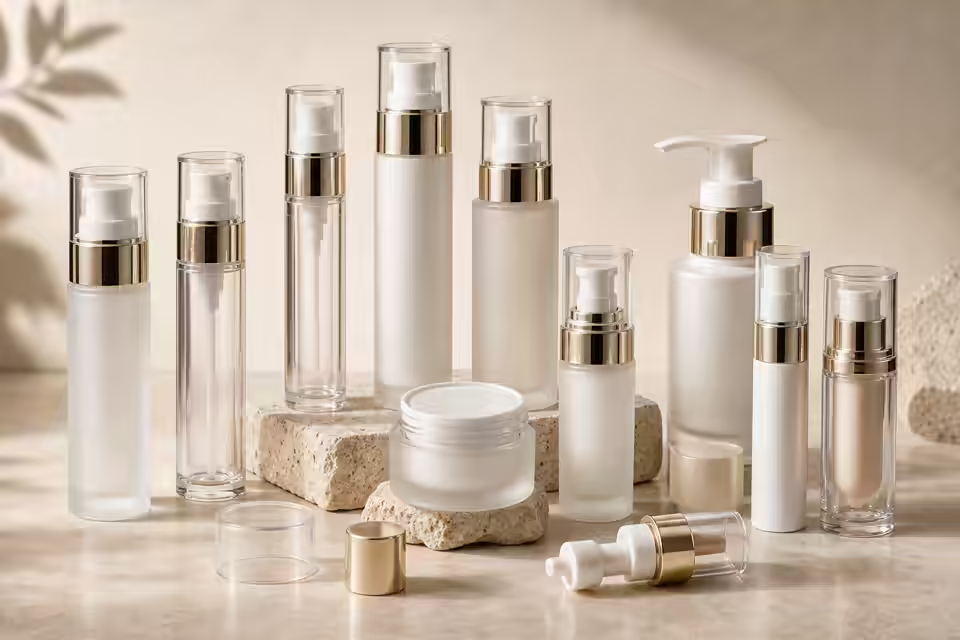
Airless Pump Bottles Wholesale: Verify the Full System
A wholesale airless bottle quote should identify piston or pouch structure, formula-contact parts, pump and actuator, fill method, priming, target dose, evacuation, decoration, refill route, carton quantity and destination. Compare the complete system with production-intent samples; the word “airless” alone does not establish compatibility, output or usable evacuation.
How should a buyer choose an airless pump bottle?
Short answer: Choose an airless pump bottle from the formula, filling process and target dispensing behavior. Define viscosity, fill volume, dose, product-contact materials, piston or pouch construction, fill opening, priming, actuator lock, refill route and packed orientation. Then test production-intent components for filling, repeated output, leakage, actuator return and usable evacuation. “Airless” alone does not prove compatibility, zero oxygen exposure, complete evacuation or shelf-life performance.
Compare the system before sampling
These routes are shortlist directions. Current model, component, decoration and sample availability must be confirmed for the selected formula, filling line, quantity, destination and approval scope.
| Formula or use starting point | Route to compare | Confirm with production-intent parts |
|---|---|---|
| Flowable serum, lotion or liquid complexion formula | Piston airless bottle or plastic airless candidate | Viscosity, fill opening, piston position, pump pathway, target dose, priming, repeated output, actuator return and evacuation endpoint. |
| Eye care, spot treatment or another concentrated application | Mini airless pump format | Fill volume, target dose, actuator geometry, cap clearance, application action, leakage and packed orientation. |
| Cream or higher-viscosity formula | Wide-body airless bottle, top-dispensing jar or another pump configuration | Filling method, formula flow, inlet and pathway, priming, dose consistency and usable evacuation. Compare the use action with the airless bottle versus jar guide. |
| Replaceable-cartridge or refill brief | Reusable outer pack with inner cartridge | Formula-contact parts, cartridge and shell interface, refill action, assembly cycles, pump continuity, labeling and destination requirements. |
| Travel, shipping or an actuator-lock requirement | Twist-lock or lockable airless route | Lock state, accidental actuation, cap or collar fit, leakage in relevant orientations and protection in the final shipping pack. |
| Two formulas kept separate until dispensing | Dual-chamber system, subject to current configuration availability | Independent contact paths, fill sequence, target output from each chamber, mixing action, closure and repeatability with both production-intent formulas. |
Catalog Starting Points
Use individual product pages to identify a geometry or mechanism for discussion; they are not formula-compatibility or performance approvals.
Build an airless packaging RFQ
Include the operating inputs that determine the container, pump, filling and approval route instead of requesting a price from capacity alone.
Compatibility Scope
Use the actual formula and every product-contact component. Define observations, orientations, conditions and acceptance criteria for the selected project with the compatibility-testing guide.
Dispensing and Evacuation
Record priming, target output, repeated actuation, actuator return, leakage and the normal-use endpoint. The evacuation guide explains how to avoid an unsupported “complete emptying” claim.
Packed Route
Review the selected lock, cap, decoration and assembled pack in relevant orientations and distribution conditions. A component-level result does not establish performance for the finished shipping configuration.
Common Buyer Questions
How should a buyer choose an airless pump bottle?
Start with formula viscosity, fill volume, dose, filling method and intended use. Compare the exact piston, pouch, pump, actuator, refill and cap construction, then use production-intent samples to verify filling, priming, repeated output, leakage and evacuation. The airless label alone is not a project-specific compatibility or shelf-life approval.
Can an airless bottle be refillable?
Some airless formats use a reusable outer shell and replaceable inner cartridge. Confirm the complete component set, refill action, formula-contact parts, assembly cycles, pump continuity and destination requirements for the selected configuration before describing the pack as refillable.
What should be tested before ordering airless packaging?
Define project-specific checks for formula-contact compatibility, filling, priming, dose or output, actuator return, leakage in relevant orientations, evacuation to a stated endpoint, decoration durability and packed distribution. The test plan should use the actual formula and production-intent components.
Continue the airless skincare cluster
Connect the airless system to skincare applications, formula compatibility, product evacuation and refill decisions before approving a bottle and pump.